
Canada’s stoic brewing history can be traced back to one year: 1982. It took the dream of three Canadian bar hoppers who grew sick of the lack of variety when it came to their beer choices. Three years later, after the rise and fall of their pub, the Horseshoe Bay Brewpub, something else rose from its ashes: micro brewing.
In 1984 the first micro brewery was opened and several months later there were breweries shooting up all over the country, marking a renaissance in micro brewing. These breweries would give birth to the start of craft movement in Canada. Although it wasn’t universally loved at first, the crafts would slowly gain a following, culminating with many of these micro breweries merging with the big name brewers in the country.
It wasn’t until the 90s that crafts would gain its second wind. One after another, new breweries were opening their doors, and what made them different from their 80s counterparts was the addition of pale ales, IPAS, and porters. These choices were completely foreign to the traditional beer drinker in Canada.
Currently the craft scene seems to be going for the hat trick. Recently Canada has seen the opening of more breweries. What they will put on the table that their previous incarnations didn’t is anyone’s guess, but judging by their past experiences, the next few years are going to be great for any Canadian craft fan ready to get a taste of what micro brewing has in store.
Our annual BeerFest in Edmonton offers some of the best selections from the micro brewing community. Those interested in attending the event in 2018 can keep up to date by liking our Facebook page.

Today breweries with many locations have the ability to create consistent beer brands and taste. A-B has 12 locations in the United States and Budweiser has 50 breweries located around the world. Red Hook Ale opened two breweries one in Seattle Washington in 1981 and later in Portsmouth New Hampshire. All these breweries have consistent taste in their brands.
Many companies open more than one brewery because of customer demand and the ability to ship ale more economically. Many municipalities offer significant financial incentives to attract breweries. Karl Ockert, director of brewing operations at Deschutes Brewery, says that as craft brewers it all about flavor.
A company will develop a recipe for a beer and when they open in another location give the recipe to the new staff. Some owners will let the staff make the brew their way or on the other extreme supervise them and make sure it is exactly the same. Green Flash Brewing Company has duplicated its San Diego location in Virginia. It has the same layout, brew house, and production tanks.
Some breweries have batches of beer brewed at one location than shipped to the new one. They owner wants to know how the batch tastes. Many breweries use the same supplier for base malts, specialty malts, and hop lot blends for their brands. Sensory and analytic programs in breweries leads to brew consistency in multiple locations.
Photo by Alexas_Fotos (Pixabay)

David Nutt, a neuro-scientist from Great Britain, is introducing alcosynth, a synthetic beverage which he says is 100 times safer than alcohol. His product promises to give users the experience of drinking beer without having to suffer the negative effects the morning after. Alcosynth is currently undergoing testing for public consumption, and its long-term effects are not yet known.
Because alcosynth is free from a compound called acetaldehyde, Nutt explains that it will not produce a hangover after a night of drinking. Acetaldehyde is a toxin produced by the body while drinking that causes hangovers and that can accumulate in the body faster than it can be gotten rid of. The unpleasant side effects of nausea, headache, and dry mouth can be then exacerbated by dehydration.
Alcosynth has a calming on the body in a similar way to alcohol without hurting organs like the liver and kidneys. David Nutt has expressed caution over interfering overly much with the neurotransmitter GABA that is responsible for lowering anxiety in people. He states that products like his affect the system which is responsible for pleasure, and that when taken in excess, it can have unintended consequences. Moderation, even with synthetic beer, is key.
Nutt is also concerned with reducing the problems related to alcohol abuse, such as missed work and lowered job performance. Cited as a concern, is also the fact that users will often drink again in order to alleviate the symptoms of a hangover. Alcosynth has been found to be virtually calorie-free, however it is not yet known whether it is habit-forming or if a person can overdose. More testing is needed.
Photo by alles (Pixabay)
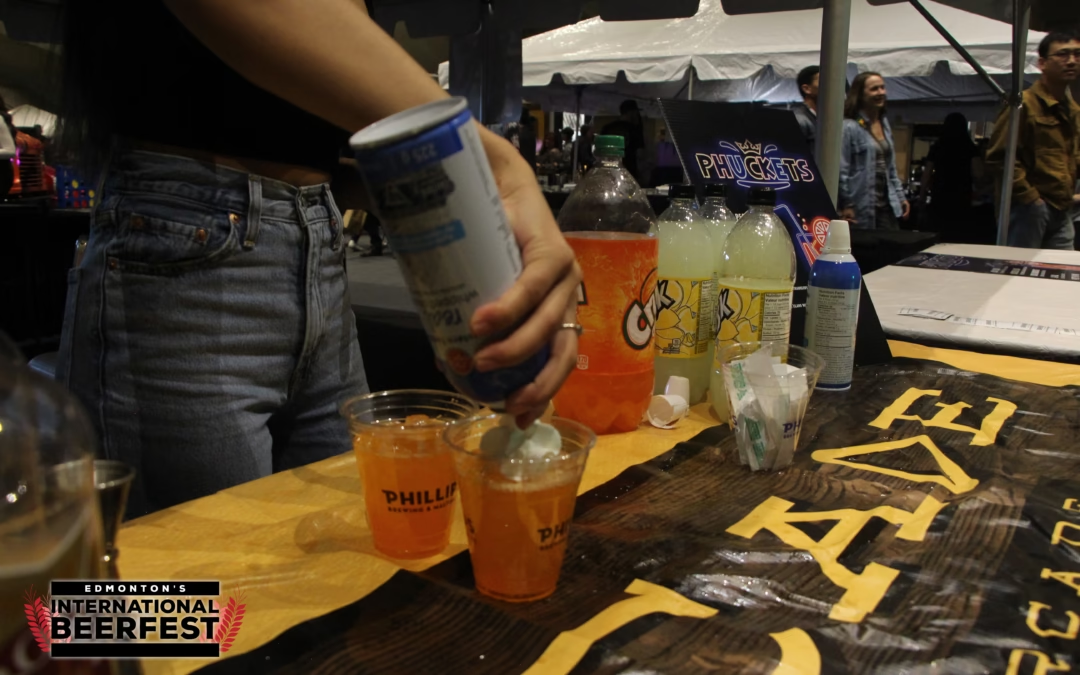
Patrons no longer walk into a bar and order a bottle of lager. Beer drinkers have evolved into connoisseurs of craft beers and specialty brews. If you’ve ever attended the Edmonton Beerfest, you know that the flavor possibilities are endless. We’ve compiled a list of the weird and wonderful ingredients used to create some of these crazy concoctions.
Collagen
Collagen is the protein that holds the human body together. Precious, a light lager beer crafted by Suntory Holdings Limited, is infused with collagen. The intoxicant allows you imbibe while getting a beauty boost.
Pizza
Who doesn’t love pizza? There’s no denying that pizza and beer taste great together. The Seefurth family decided to wrap a cooked margarita pizza in cheesecloth and soak it in mash, like a tea bag. Mamma Mia’s pizza beer was born.
Animal Testicles
Rocky Mountain oysters is a more polite way to say animal testicles. It may seem like a weird ingredient to add to beer, but Denver’s Wynkoop Brewing Company created Rocky Mountain Oyster Stout, a savory beer that pairs well with red meat.
Goat Brains
Walking Dead fans visiting the Edmonton Beerfest may be seeking brains. Luckily, goat brains are an ingredient in Dock Street Brewing Company’s Walker beer.
Feces
Mikkeller, a Denmark Microbrewery, has created an oatmeal stout called Beer Geek Brunch Weasel. The brew gets its coffee flavor from the excrement of weasel-like civets.
Photo by Bernt Rostad 

The first pumpkin ale is believed to have been created in the eighteenth century when the hardy and innovative pioneers used local ingredients, such as pumpkins, to brew ales. Back then, pumpkins were readily available, and their fermentable sugars filled in for the malt required to make beer.
As conventional beer ingredients such as barley became more accessible in the nineteenth century, the reserves of beers made from pumpkins dwindled to extinction. In the mid-1800s, pumpkin ale made a partial-comeback in the form of beers flavored with pumpkin rather than made directly from it.
It was not until the 1980s when the brew made a proper comeback in the form of a flavorful variation. A brewpub owner in California created a beer with pumpkin and added some pie spices for flavor. This combination was later known as “pumpkin zombies.”
In Canada, the interest in Pumpkin beers re-emerged in 2004 when the Windsor Pumpkin Festival requested Halifax’s Propeller Brewing Company to create a beer showcasing the giant gourd – from the huge Jabba-the-Hutt-like pumpkin variety grown by Danny Dill in Windsor, N.S. The drink has been brewed since.
There are tens of varieties of pumpkins, with some giant ones referred to as the Jabba-the-Hutt-like variety, weighing as much as 2,009 pounds. But this variety is not as sweet as pie pumpkins. So, brewers prefer to use light, bready pale malts to create the golden ale that allows the notes of fresh pumpkin pulp and spicy clove to shine.
36,000 pints of the pumpkin zombie can be brewed from around 1,000 giant pumpkins, but the demand for the drink exceeds the supply. The season for pumpkin beers starts around August, but the stock is usually depleted by Halloween.
There are now many varieties of Pumpkin beer, most of which use a combination of pie spices: allspice, nutmeg, cloves, ginger, and cinnamon. One particularly interesting variety has a hefty caramel and graham-cracker base that evokes pumpkin-pie in a pint.
Most pumpkin beers sell-through very fast during the Halloween season owing to the increased number of parties around that time. The alcohol content in pumpkin beer is sometimes higher than standard beers, like the Pumpkin Abbey ale at 9.5 percent, but it is still a favorite among locals, especially in the weeks leading up to Halloween.
Photo Credit: Pixabay.com

Modern beer drinkers want variety. They want tasty, quality beers. They are not as committed to beer brands as their parents and are willing to explore new breweries and fresh flavors. Their thirst and discerning palates led to the craft beer revolution and ongoing evolution.
The recent past has been great. In 2016, we can expect more breweries to enter the market. Here are few expected trends for the industry locally and abroad.
Craft Beer Will Get Better
Craft brewers owe their market share to discerning consumers. With so many breweries in the same region, community goodwill is no longer enough. Quality beer is the only competitive edge for those who want to stay afloat. As a beer drinker, 2016 will be an exciting year loaded with tasty quality brews.
Session Beer will Rule
In 2015, Session became the new way to qualify beer. In 2016, Session will continue to rise and dominate. Almost every beer style will bear “Session” labels.
More Limited Release Beers
Release days for limited release bottles have caused a frenzy in the past. In 2016, demand for rare or unique versions will peak. Consequently, you can expect more bottle frenzies.
Return to Lagers
Lagers are hard to produce. They require long fermentation time and more capital. Additionally, craft brewers sensed a “lager-fatigue” in Canadian beer fans. For the mentioned reasons, craft brewers have been ignoring lagers.
However, things have changed. Consumers are demanding crisp, clean light-bodied lagers. And there are new lager yeasts that promise more variety. You can expect more experimental lagers in 2016.
Buyouts and Mergers
Microbrewers have made considerable inroads. The big brands can be expected to fight for their dwindling market share. 2016 will witness more aggressive marketing and perhaps buyouts, mergers and Big Beer’s control of distribution networks.
More Import Craft Beer Locally
Craft beer consumer base in Canada is thriving. More dealers will look to export their craft brands to Canada. Notably, you can expect more American craft beer in local liquor stores.
Single-Malt Beers
Industry observers predict that specialty malts will become as important as hops. Brewers will use the same base malt but a single specialty malt for their ales.
Photo Credit: Pixabay.com


